
It's been Spring in Los Angeles for the last two weeks. While we still have cooler than normal temperatures, life is beautiful here in Los Angeles. This is what we pay the big bucks in houses, mortgages, and taxes for: the scenery and the chance to experience it with our five senses. This is why my friend, Joe, and countless thousands of other transplants like him like to call their friends "back home" and razz them about the 80-degree sunshine and everyone in shorts and flip-flops while they freeze for the 80th day in a row in sub-freezing temps.
While film after tv show makes everyone believe that Los Angeles is one neverending palm and surfing Malibu Beach, L. A.'s scenery elsewhere is even more spectacular.
L. A. has two giant parks: Griffith Park, the largest city park in the United States; and Elysian Park, a huge remnant of the land the Tongva Indians lived in and the Spanish found in 1769. Running alongside both of these massive "green lungs" is the Los Angeles River. I am lucky to live in between all three of them.
I experienced my "Eat Your Heart Out, You Non-Angelinos" moment last Sunday. I love going to the Atwater Village Farmers Market. I remember Atwater Village when it was just Atwater but changing a neighborhood's name to "Village" to make a house worth 1/3 more than it was before is another blog entry for another time :-). It's one of the liveliest, funnest, culturally and culinarily eclectic farmers markets in a city filled with those types of farmers markets.
Where else but at a L. A. farmers market can you breakfast on pupusas and Korean short ribs, followed by a raw sugar cane juice chaser and finish it off, al fresco, with a pain au chocolat and espresso, then get your energy cleared and your chakras up and running like they should by an acupuncturist.
I decided to walk there. It's two miles from my house to the market but it was a gorgeous Sunday morning and I wanted to feel the sunshine, clear blue sky and nature along the L. A. Riverwalk.

MrLA leads you on a journey through the restaurants, bars, clubs, muesuems, neighborhoods, festivals, and everything else that makes living in this beautiful, exciting, complex city a one-of-a-kind experience, as only a native Angeleno knows(I'm so Angeleno I live in the same house in Northeast Los Angeles that I grew up in). See L. A. with me as only someone who has lived his entire life here knows it.
Monday, April 23, 2012

Saturday, April 21, 2012
Foodtruck Heaven
After the holidays and some issues that took much more time and attention than I wanted, I'm back and, like the old saying says, "The way to a man's heart is through his stomach", what led me post for my first post of 2012 was food.
I planned a social event in February where I was supposed to meet members of a meetup group I organize at the Los Angeles County Museum of Art (LACMA), Mr. LA's second home for more than 3--- years. Much to my most pleasant surprise, the entire other side of the museum was covered with food trucks offering the world in culinary offerings. You want Mexican food, you got it there; Need to get your Berliner curry wurst fix fixed fast; or you have a hankering for an organic, handmade ice cream sandwich on gourmet dark chocolate chip cookies, enter Foodtruck Heaven, on Wilshire Blvd. between Spaulding and Genessee Avenues. They're in front of the L. A. Fitness on the side opposite LACMA.
How L. A. to eat your gourmet foodtruck meal and work it off in the same location! How also L. A. it is to eat Korean tacos, something you can get at the Galbi food truck in Foodtruck Heaven! For those of you who have no idea what I'm talking about or have heard of one but have not yet ventured to try one, a Korean taco is a Southern California invention. Someone thought that serving galbi, Korean short ribs, on a Mexican tortilla, stuffed with the usual taco toppings, was in for a treat. You are! Korean tacos are as L. A. as the palm tree or Friday night bike riders and girls with barely enough skirt and stiletto heels at the Hollywood nightclubs. A food revolution was born!!!
Suddenly, Twitter became a reservation book as the Korean taco truck published its latest locations all over Los Angeles. Hundreds weekly flocked to have this latest craving, opening the door (pun not so intended) to trucks featuring every kind of food imaginable.
There is more than one "foodtruck heaven". The one on Breed Street in Boyle Heights will have 20 different trucks, each selling a particular type of Mexican sandwich or food. They park at night in a parking lot off of Breed and Cesar Chavez Ave. Where are the best tacos in Los Angeles? At the Ay, Que Tacos Leonor food truck on 3rd and Indiana Streets in East L. A. I defy anyone to find a better taco anywhere. You've been to Japan and you are craving the massive (as big as a frying pan) pancake known as a "onokomiyaki"? Besides going to a restaurant in Gardena, the only other place to get these succulent, meaty, vegetabley, lightly breaded square of food heaven will be courtesy of Glowfish, a food truck that parks on Friday and Saturday nights in front of the Spaceland Nightclub on Silver Lake Blvd.
But the Foodtruck Heaven I'm talking about here offers trucks that serve sandwiches from all of the Latin American countries, Korean tacos, Indonesian food, Berlin currywurst, Mexican food, French crepes, and of course, burgers and hot dogs (we are in America, after all!). All this and ice cream sandwiches made from organic, artisanal gelato and organic cookies, too!


 So, support your local foodtruck heaven. You'll be glad you did!
I planned a social event in February where I was supposed to meet members of a meetup group I organize at the Los Angeles County Museum of Art (LACMA), Mr. LA's second home for more than 3--- years. Much to my most pleasant surprise, the entire other side of the museum was covered with food trucks offering the world in culinary offerings. You want Mexican food, you got it there; Need to get your Berliner curry wurst fix fixed fast; or you have a hankering for an organic, handmade ice cream sandwich on gourmet dark chocolate chip cookies, enter Foodtruck Heaven, on Wilshire Blvd. between Spaulding and Genessee Avenues. They're in front of the L. A. Fitness on the side opposite LACMA.
How L. A. to eat your gourmet foodtruck meal and work it off in the same location! How also L. A. it is to eat Korean tacos, something you can get at the Galbi food truck in Foodtruck Heaven! For those of you who have no idea what I'm talking about or have heard of one but have not yet ventured to try one, a Korean taco is a Southern California invention. Someone thought that serving galbi, Korean short ribs, on a Mexican tortilla, stuffed with the usual taco toppings, was in for a treat. You are! Korean tacos are as L. A. as the palm tree or Friday night bike riders and girls with barely enough skirt and stiletto heels at the Hollywood nightclubs. A food revolution was born!!!
Suddenly, Twitter became a reservation book as the Korean taco truck published its latest locations all over Los Angeles. Hundreds weekly flocked to have this latest craving, opening the door (pun not so intended) to trucks featuring every kind of food imaginable.
There is more than one "foodtruck heaven". The one on Breed Street in Boyle Heights will have 20 different trucks, each selling a particular type of Mexican sandwich or food. They park at night in a parking lot off of Breed and Cesar Chavez Ave. Where are the best tacos in Los Angeles? At the Ay, Que Tacos Leonor food truck on 3rd and Indiana Streets in East L. A. I defy anyone to find a better taco anywhere. You've been to Japan and you are craving the massive (as big as a frying pan) pancake known as a "onokomiyaki"? Besides going to a restaurant in Gardena, the only other place to get these succulent, meaty, vegetabley, lightly breaded square of food heaven will be courtesy of Glowfish, a food truck that parks on Friday and Saturday nights in front of the Spaceland Nightclub on Silver Lake Blvd.
But the Foodtruck Heaven I'm talking about here offers trucks that serve sandwiches from all of the Latin American countries, Korean tacos, Indonesian food, Berlin currywurst, Mexican food, French crepes, and of course, burgers and hot dogs (we are in America, after all!). All this and ice cream sandwiches made from organic, artisanal gelato and organic cookies, too!


Hi, Guys:
I'm back after tackling life issues that kept me away but I'm back.
Flash!!! Tomorrow Olvera Street celebrates its 82nd anniversary of being a Mexican marketplace. There is a jam-packed list of events for kids, adults, and just general partying. It'll be amazing as mariachi bands, Aztec dancers, salsa and marimba groups, mass baptisms at the Plaza Church, massive lines at the taquito stands along the way. For those going there, getting there on the 2 Bus along Sunset Blvd. will put you within one block of Olvera Street. The Metro Red Line will bring you from the San Fernando Valley. The Green and Blue Lines will bring you in from the South Bay and the Gold Line will bring you in from Pasadena and points between it and Los Angeles. Parking (if you must) can be had for $7.00 the entire day (the cheapest rate around there) at the Metro Plaza Hotel, cr. Main St. and Cesar Chavez Ave., diagonally across Olvera Street.
For those who might not know, Olvera Street is where the oldest buildings in Los Angeles are congregated. Really, a glorified alley during the Spanish and Mexican days in Los Angeles, it was really that until the 1920's when, rundown buildings everywhere, drug deals, prostitution, bootleg liquor sales, and all kinds of violent crime were happening there. Leave it to someone outside of L. A. to value and save historical landmarks.
Christine Sterling, a San Francisco socialite, visited Los Angeles many times and became enamored of its history. When she saw the decrepit street and the Avila Adobe being readied to demolish, she took it upon herself to save the house and the entire street, restoring it to its former glory and saving L. A.'s origins, turning it into a marketplace and inviting people from all over the globe to see it. She had the ears, eyes, and money of Harry Chandler, the publisher of the Los Angeles Times 24/7. Through Chandler, Ahmanson, and many other major economic players in Los Angeles, Mrs. Sterling got the City of Los Angeles (when it had money............Don't get me started on THAT topic!) to clean up the street, pave it with bricks, restore the ditch that used to bring fresh water from the Los Angeles River to the houses on Olvera Street, invite Mexican business owners, and the rest came together on April 21, 1930, with the mayor, Harry Chandler, newsreels (the movie theater version of the nightly news), and thousands of people attending the ribbon-cutting ceremony.
Many of the original business owners still operate the shops and restaurants on Olvera Street, albeit the great-grandchildren of the original owners. Olvera Street remains one of the most famous and most popular tourist attractions in Los Angeles.
For my money, the best Mexican meal on the street is at La Luz del Dia, a cafeteria containing freshly-ground and -made tortillas right in front of you; the best carnitas in Los Angeles; and the best nopales, a citrusy salad made of diced cactus, onions, tomatoes, cilantro, lemon juice, salt, and some diced chilis, in town. Although Olvera Street was made into a Mexican marketplace and, indeed, it pays tribute to the city's Spanish roots and Mexican character, there are several reminders of other ethnic groups with strong ties to Olvera Street: the Chinese-American Museum on the southern end of the Plaza, next to the Pico House, a great and long-overdue museum that fascinatingly chronicles the history of the Chinese in California, especially Los Angeles. Don't miss photos of the Massacre of 1871, the worst mass violent episode in the United States for the next 50 years. Also, nearby though not open is the Italian Hall, site of the once huge Italian immigrant community in Los Angeles. To all you New Yorkers, L. A. had its own Little Italy and it was bigger than yours, nahh na ne na nahh! When you have a great margarita and good Mexican dinner at La Golondrina on Olvera Street, you'll be eating at the home of Antonio Pelanconi, one of the earliest Italians in Los Angeles and one of the biggest landowners in L. A. County and one of the pioneers of the wine industry in California.
Enjoy a margarita, a taquito or a carnitas plate (more than one of each if you like) and "Viva la Placita Olvera" on its 82nd birthday!!!
I'm back after tackling life issues that kept me away but I'm back.
Flash!!! Tomorrow Olvera Street celebrates its 82nd anniversary of being a Mexican marketplace. There is a jam-packed list of events for kids, adults, and just general partying. It'll be amazing as mariachi bands, Aztec dancers, salsa and marimba groups, mass baptisms at the Plaza Church, massive lines at the taquito stands along the way. For those going there, getting there on the 2 Bus along Sunset Blvd. will put you within one block of Olvera Street. The Metro Red Line will bring you from the San Fernando Valley. The Green and Blue Lines will bring you in from the South Bay and the Gold Line will bring you in from Pasadena and points between it and Los Angeles. Parking (if you must) can be had for $7.00 the entire day (the cheapest rate around there) at the Metro Plaza Hotel, cr. Main St. and Cesar Chavez Ave., diagonally across Olvera Street.
For those who might not know, Olvera Street is where the oldest buildings in Los Angeles are congregated. Really, a glorified alley during the Spanish and Mexican days in Los Angeles, it was really that until the 1920's when, rundown buildings everywhere, drug deals, prostitution, bootleg liquor sales, and all kinds of violent crime were happening there. Leave it to someone outside of L. A. to value and save historical landmarks.
Christine Sterling, a San Francisco socialite, visited Los Angeles many times and became enamored of its history. When she saw the decrepit street and the Avila Adobe being readied to demolish, she took it upon herself to save the house and the entire street, restoring it to its former glory and saving L. A.'s origins, turning it into a marketplace and inviting people from all over the globe to see it. She had the ears, eyes, and money of Harry Chandler, the publisher of the Los Angeles Times 24/7. Through Chandler, Ahmanson, and many other major economic players in Los Angeles, Mrs. Sterling got the City of Los Angeles (when it had money............Don't get me started on THAT topic!) to clean up the street, pave it with bricks, restore the ditch that used to bring fresh water from the Los Angeles River to the houses on Olvera Street, invite Mexican business owners, and the rest came together on April 21, 1930, with the mayor, Harry Chandler, newsreels (the movie theater version of the nightly news), and thousands of people attending the ribbon-cutting ceremony.
Many of the original business owners still operate the shops and restaurants on Olvera Street, albeit the great-grandchildren of the original owners. Olvera Street remains one of the most famous and most popular tourist attractions in Los Angeles.
For my money, the best Mexican meal on the street is at La Luz del Dia, a cafeteria containing freshly-ground and -made tortillas right in front of you; the best carnitas in Los Angeles; and the best nopales, a citrusy salad made of diced cactus, onions, tomatoes, cilantro, lemon juice, salt, and some diced chilis, in town. Although Olvera Street was made into a Mexican marketplace and, indeed, it pays tribute to the city's Spanish roots and Mexican character, there are several reminders of other ethnic groups with strong ties to Olvera Street: the Chinese-American Museum on the southern end of the Plaza, next to the Pico House, a great and long-overdue museum that fascinatingly chronicles the history of the Chinese in California, especially Los Angeles. Don't miss photos of the Massacre of 1871, the worst mass violent episode in the United States for the next 50 years. Also, nearby though not open is the Italian Hall, site of the once huge Italian immigrant community in Los Angeles. To all you New Yorkers, L. A. had its own Little Italy and it was bigger than yours, nahh na ne na nahh! When you have a great margarita and good Mexican dinner at La Golondrina on Olvera Street, you'll be eating at the home of Antonio Pelanconi, one of the earliest Italians in Los Angeles and one of the biggest landowners in L. A. County and one of the pioneers of the wine industry in California.
Enjoy a margarita, a taquito or a carnitas plate (more than one of each if you like) and "Viva la Placita Olvera" on its 82nd birthday!!!
Tuesday, November 22, 2011
Yes, Virginia, It Rains (and Snows) in Los Angeles!
The "weather watches" on all local tv stations in which the weather reporters solemnly, gravely tell us of the dangerous rains coming to Los Angeles; It's too cold; It shouldn't be raining this much in November; This is unusual for this time of year; This isn't the weather I signed up for when I moved to Los Angeles. Even CNN has their anchors soberly commenting on the impending rainstorms up and down the California coast while flashing on a California map.
People, you've learned a fact of Angeleno life: it rains, often heavily in southern California. In the mountains and high deserts, it snows most every year. In Los Angeles, once every 30 years, there'll be measurable snow on the ground, sometimes a foot of snow. That's something the Greater Los Angeles Convention and Visitors Bureau doesn't want you to know.
The Los Angeles River is not a concrete ditch. It might look like it. Some parts of it have trees and grass growing inside it to make you think a pretty nothing of a stream is returning to its original state but the river has always http://www.youtube.com/embed/piRer4CFoWQ been and continues to be the outpouring of massive amounts of rain that hit Los Angeles, usually before Halloween and lasting until early April. Like most Americans, Angeleno's memories can be very short. Only last year did we have one of the heaviest rainfalls ever
http://www.youtube.com/embed/9Z9OI3s5iG0. This is not merely global warming or climate change. El Nino and La Nina are bywords of life in Los Angeles. These alternate 7-year cycles bring chains of record rainstorms, flooding, and snowstorms. They are the lifeblood of all 17 million of us who live in the Los Angeles area to allow us and the neverending supply of newcomers to live the California lifestyle that films and fiction have created.
Along with Standard Oil and General Tire killing off the Red Car and all L. A. women looking like Pam Anderson on "Baywatch" along Santa Monica Beach, another long-running L. A. myth is that Los Angeles is a desert and would have stayed a desert without importing water. Go back to Gaspar de Portola's journal description of the San Fernando Valley (hot, dry desert that so many people believe it is) when he and Father Serra first walked through it in 1769, claiming the land for Spain, "...We came upon a valley so full of oaks and junipers that we couldn't see the sun for miles upon miles, so restful and pleasant was our journey through it..." The San Fernando Valley, covered with oaks and junipers? It was.
Rodeo Drive wasn't called Rodeo Drive because either rodeos were held there or because an early fashion designer named Rodeo opened the first store there. Rancho Rodeo de las Aguas was one of the richest and longest-lasting ranchos and prime Beverly Hills real estate not because movie stars were moving there but because of a group of springs that opened up water to the intersection of Sunset Blvd. and Beverly Drive, right where the Beverly Hills Hotel is today, provided abundant water for settlement. Slauson Creek, Ballona Creek, Rio Hondo, the San Gabriel River, Big Dalton Wash, Pacoima Creek. These are not the hallmarks of a desert. The Los Angeles River used to receive so much rainfall that the river jumped its banks, spilled over and created the riverbed it has today. It's old riverbed we now know as Ballona Creek. Most streams in and around L. A. still run in the very dry summers in Southern California, even if just a trickle.
The San Fernando Valley is hot because so many people moved here: the oaks, junipers, and the wildlife it supported were removed and paved over, denuding the land and making it hotter for people to live. The same is true for all of the Los Angeles Basin, which used to support forests, abundant game, and a lot of bodies of water before land developers did to it what was done to the Valley. It became a desert by land development until city governments began planting trees and residents added their own gardens to the mix.
Los Angeles has a Mediterranean semi-arid climate. That means hot dry summers, mild fall and spring weather, and mild winters, though very wet ones and often cold enough to bring on weeks of sweaters and coats (although no matter how cold it gets, transplants from the East Coast have created L. A. cold weather gear: down jackets, ski hats, and flip flops).
Yes, the sun is out most days of the year. Yes, we can have 85 degree clear weather on Christmas Day and New Year's Day that tricks people into believing Los Angeles is a sun-drenched paradise with no other weather. Guess again!
The Land of Eternal Summer also sees its ground covered with snow, approximately every 25 years. My parents and other relatives would comment about the Great Snowfall of 1949, when they threw snowballs at each other and recorded it in photographs. Pecos Bill's BBQ on Victory Blvd., near Western Ave. in Glendale still has photos that it's founder took of the snow surrounding his business in 1949. By the way, some of the best bbq in this city can still be found there. I kept waiting and waiting for the next snowfall. My grandmother had told me about the 1931 snowfall that actually shut down some roads in the city. By my calculations, I would expect snow in Los Angeles approximately every 20 years. 1969 came and went. So did 1979. I thought the snowfall was a great big myth until February, 1987, there was a Los Angeles Herald-Examiner photo of snow patches on the sand at Huntington Beach. There was a film of snow on my car and those of everyone on my block. Within two hours of it falling, it melted but it was snowfall.
One of the joys of living in Los Angeles is the beautiful, warm days with clear skies that let you see Catalina Island from Mt. Wilson, fall foliage from the native willow and cottonwood trees in the canyons, and the lush green mountainsides with wild mustard yellow and fire-engine orange poppies carpeting those mountains. It happens every late fall-through early spring and it's a gorgeous sight to behold. Skater boys, club hounds, aspiring actors, musicians, and anyone describing themselves as trendy and living from Silver Lake west, realize the beauty that we Angelenos are given at this time of year is here for everyone to enjoy and that it comes from the sometimes heavy, cold rains that mark our rainy season, which usually runs from just before Halloween to just after Easter, though we can get occasional tropical storms during the summer. Next time you're "hit unaware" by the rain and you don't understand why there's so much rain, remember, it rains (and snows) in Los Angeles. That's something I'll always "sign up" for, although I only want to enjoy the rain from the comfort and reclined position of my bed looking out the window and not on the 405-10 Interchange.
People, you've learned a fact of Angeleno life: it rains, often heavily in southern California. In the mountains and high deserts, it snows most every year. In Los Angeles, once every 30 years, there'll be measurable snow on the ground, sometimes a foot of snow. That's something the Greater Los Angeles Convention and Visitors Bureau doesn't want you to know.
The Los Angeles River is not a concrete ditch. It might look like it. Some parts of it have trees and grass growing inside it to make you think a pretty nothing of a stream is returning to its original state but the river has always http://www.youtube.com/embed/piRer4CFoWQ been and continues to be the outpouring of massive amounts of rain that hit Los Angeles, usually before Halloween and lasting until early April. Like most Americans, Angeleno's memories can be very short. Only last year did we have one of the heaviest rainfalls ever
http://www.youtube.com/embed/9Z9OI3s5iG0. This is not merely global warming or climate change. El Nino and La Nina are bywords of life in Los Angeles. These alternate 7-year cycles bring chains of record rainstorms, flooding, and snowstorms. They are the lifeblood of all 17 million of us who live in the Los Angeles area to allow us and the neverending supply of newcomers to live the California lifestyle that films and fiction have created.
Along with Standard Oil and General Tire killing off the Red Car and all L. A. women looking like Pam Anderson on "Baywatch" along Santa Monica Beach, another long-running L. A. myth is that Los Angeles is a desert and would have stayed a desert without importing water. Go back to Gaspar de Portola's journal description of the San Fernando Valley (hot, dry desert that so many people believe it is) when he and Father Serra first walked through it in 1769, claiming the land for Spain, "...We came upon a valley so full of oaks and junipers that we couldn't see the sun for miles upon miles, so restful and pleasant was our journey through it..." The San Fernando Valley, covered with oaks and junipers? It was.
Rodeo Drive wasn't called Rodeo Drive because either rodeos were held there or because an early fashion designer named Rodeo opened the first store there. Rancho Rodeo de las Aguas was one of the richest and longest-lasting ranchos and prime Beverly Hills real estate not because movie stars were moving there but because of a group of springs that opened up water to the intersection of Sunset Blvd. and Beverly Drive, right where the Beverly Hills Hotel is today, provided abundant water for settlement. Slauson Creek, Ballona Creek, Rio Hondo, the San Gabriel River, Big Dalton Wash, Pacoima Creek. These are not the hallmarks of a desert. The Los Angeles River used to receive so much rainfall that the river jumped its banks, spilled over and created the riverbed it has today. It's old riverbed we now know as Ballona Creek. Most streams in and around L. A. still run in the very dry summers in Southern California, even if just a trickle.
The San Fernando Valley is hot because so many people moved here: the oaks, junipers, and the wildlife it supported were removed and paved over, denuding the land and making it hotter for people to live. The same is true for all of the Los Angeles Basin, which used to support forests, abundant game, and a lot of bodies of water before land developers did to it what was done to the Valley. It became a desert by land development until city governments began planting trees and residents added their own gardens to the mix.
Los Angeles has a Mediterranean semi-arid climate. That means hot dry summers, mild fall and spring weather, and mild winters, though very wet ones and often cold enough to bring on weeks of sweaters and coats (although no matter how cold it gets, transplants from the East Coast have created L. A. cold weather gear: down jackets, ski hats, and flip flops).
Yes, the sun is out most days of the year. Yes, we can have 85 degree clear weather on Christmas Day and New Year's Day that tricks people into believing Los Angeles is a sun-drenched paradise with no other weather. Guess again!
The Land of Eternal Summer also sees its ground covered with snow, approximately every 25 years. My parents and other relatives would comment about the Great Snowfall of 1949, when they threw snowballs at each other and recorded it in photographs. Pecos Bill's BBQ on Victory Blvd., near Western Ave. in Glendale still has photos that it's founder took of the snow surrounding his business in 1949. By the way, some of the best bbq in this city can still be found there. I kept waiting and waiting for the next snowfall. My grandmother had told me about the 1931 snowfall that actually shut down some roads in the city. By my calculations, I would expect snow in Los Angeles approximately every 20 years. 1969 came and went. So did 1979. I thought the snowfall was a great big myth until February, 1987, there was a Los Angeles Herald-Examiner photo of snow patches on the sand at Huntington Beach. There was a film of snow on my car and those of everyone on my block. Within two hours of it falling, it melted but it was snowfall.
One of the joys of living in Los Angeles is the beautiful, warm days with clear skies that let you see Catalina Island from Mt. Wilson, fall foliage from the native willow and cottonwood trees in the canyons, and the lush green mountainsides with wild mustard yellow and fire-engine orange poppies carpeting those mountains. It happens every late fall-through early spring and it's a gorgeous sight to behold. Skater boys, club hounds, aspiring actors, musicians, and anyone describing themselves as trendy and living from Silver Lake west, realize the beauty that we Angelenos are given at this time of year is here for everyone to enjoy and that it comes from the sometimes heavy, cold rains that mark our rainy season, which usually runs from just before Halloween to just after Easter, though we can get occasional tropical storms during the summer. Next time you're "hit unaware" by the rain and you don't understand why there's so much rain, remember, it rains (and snows) in Los Angeles. That's something I'll always "sign up" for, although I only want to enjoy the rain from the comfort and reclined position of my bed looking out the window and not on the 405-10 Interchange.
Sunday, January 16, 2011
Happy New Year! Here Today, Gone Tamale!

Hola, Everyone!
Happy New Year to everyone! I've been late to post because of recovering from two long flus and the holidays. I didn't let the flu deprive me of a true Los Angeles tradition. No rain, nor sleet, nor visits to the bathroom would deter MrLA from having, eating, and enjoying tamales for the holidays.
As anyone who's lived here for more than 3 months knows, tamales in Los Angeles are as common as actors answering casting calls at Paramount Studios. You can't say you've eaten Mexican food in Los Angeles without eating a tamale. True Angeleno hipsters call it by it's Spanish name: "tamal", which itself came from Nahuatl, the Aztec language that also gave us such other delicious foods as cocoa, tomato, and avocado, all part of the Mexican and Latino food scene in Los Angeles. But you don't have to be a hipster to enjoy the seemingly endless varieties of tamales now for sale at your local Mexican restaurant, Trader Joe's, Whole Foods or Bristol Farms, or the way hipsters in Echo Park, Boyle Heights, and Silver Lake eat them: from men and women who sell them on street corners, piping hot, from Igloo coolers.
MrLA grew up with tamales being only corn patties with chunks of braised pork in red chili sauce, pork in green chili sauce, and greasy (forgive me, Grandma!) sweet tamales studded with raisins, cinnamon, peanuts, and sugar, all wrapped up in corn husks and steamed for hours. Pork tamales were the only ones served in restaurants when I was growing up back in the Jurassic Era of the 1960's and 1970's. They were all covered in red chili sauce (Las Palmas Chili Sauce, which you can still find in L. A. supermarkets), and shredded cheddar cheese. This is what passed for good tamales when I was growing up. It's a wonder I grew up at all with those "artificial" tamales.
Sarah Palin and the Tea Partiers (I should get a royalty check for giving some new musicians to LA the name for their band, after they answer casting calls at Paramount and live off of tamales until they crack the Big Time) would yell and tell me otherwise but the GREAT LATINO IMMIGRATION WAVE of the 1980's brought real and varied and creative tamales to Los Angeles.
Just for starters: tamales were not just Mexican anymore. With the refugees from Guatemala, El Salvador, and Nicaragua came fat pillows of corn patties made with chicken, seafood, beef, blended with sliced green olives? capers? bell peppers? chunks of potatoes? and, most shocking of all, wrapped in banana leaves and tied in string? You betcha, as Sarah and some of her Tea Partiers would say. Add to that the immigrants from smaller though consistent streams of Colombian, Ecuadoran, Peruvian, Chilean, Cuban, Honduran, and Argentinian immigrants to Los Angeles and you had the beginning of the endless "tamale wars" amongst LAtinos. They may have fought amongst each other and put down their "competitors' " tamales but all Angelenos benefitted from the "fight". Now you had seafood tamales, cheese and green chili tamales, vegetable tamales, pureed raspberry and goat cheese tamales, and for the very vegan in the city (and one of my two favorite tamales): green corn tamales, served Salvadoran-style, with pureed refried beans and Salvadoran rice. By 1985, an Angeleno could walk a 10-block square of Hollywood and eat his or her way across 10 Latin American countries just by eating tamales. Yummmmmmmmmmmmmmmmmmmmmmmmmmmmmmmmmmmmm!
Tamales became a Bel-Air sensation thanks to the nannies and gardeners that care for the Bel-Aireans' homes. The damas of the multimillion-dollar casas loved the taste, wrappings, and stories of their nannies and gardeners pasting and wrapping hundreds of tamales with their families, assembly-line like, at Christmas. Before you could say "Montana Avenue", Los Angeles Magazine, LA Weekly, and the Times were all publishing where to buy the best tamales and sharing tamale recipes. Tamale parties given by people whose ancestors ran away from the Czars of Russia, the grand dukes of Italy, and the sultans of Turkey were hosting tamale parties in Mandeville Canyon, Beverly Hills, and Tarzana as if they were Frida Kahlo's grandmothers. Along with the burrito, cheeseburger, and Dodger dog, the tamale (and the parties to make them) became as Angeleno as I am.
Owing to the overwhelming numbers of Mexicans living in Los Angeles, the city has seen the richness, creativity, and profusion of the thousands of varieties of tamales found in Mexico. Koreatown in December would be unthinkable without tamales de mole at Guelaguetza, a chain of restaurants serving the foods of Oaxaca, Mexico. Lines that would make the Olympic Games green with envy are found on weekends and in December at Liliana's Tamales, Sandra and Lolita's, Mama's Hot Tamales Cafe or any of the street vendors selling tamales throughout the city. The Border Grill girls, Susan Feniger, and Mary Sue Milliken, made their empire based on tamales that no one had ever seen before, not even in Latin America :-). The greater, more recent immigration of southern Mexicans has brought an array of vegetarian tamales with pungent aromas, often seasoned with mole or sauces of various colors and spiciness. A tamale filled with huitlacoche, corn fungus that has the smokiness and texture of wild mushrooms, topped with a white cream sauce, garnished with sesame seeds is to know Heaven.
There have been tamale festivals in various parts of the city at different times in the last 10 years but they've all bowed out before the granddaddy (or is it el abuelito?) of all tamale festivals: the annual Tamale Festival held in Indio, California. There are literally dozens of vendors spread out of a half-mile square area selling from the most traditional to the most avant-garde. Goat cheese tamales? Beer batter tamales? Mango and green chili tamales? Go east, young man! Go east, young woman (or any man or woman) to Indio and park with thousands of tamale fans, fiends, and Facebook friends, all savoring, enjoying, weirding out (sometimes), and eating L. A.'s very own snack: the tamale.
Happy New Year! Many Tamales To You!
The Best Tamales in Los Angeles, 2011:
Mama's Hot Tamales Cafe
2122 W. 7th Street, just w. of Alvarado St.
Los Angeles, CA 90057
http://www.mamashottamales.com/
Liliana's Tamales
(two of four locations in East L. A.)
4629 E. Cesar Chavez Ave.
Los Angeles, CA 90022
(323) 780-0829
3448 1st Street
Los Angeles, CA 90063
(323) 780-0989
The Border Grill
various locations in Southern California
Antojitos Bibi (Honduran Tamales)
2400 W. 7th Street, Suite 109
Los Angeles, CA 90057
(213) 385-8595
La Adelita Food Company (Nicaraguan, Salvadoran, and Mexican Tamales)
1287 S. Union Avenue, cr. Pico Blvd.
Los Angeles, CA 90015
El Caserio (Ecuadoran Humitas)
Two locations in Silver Lake
Rincon Chileno (Chilean Humitas)
4354 Melrose Avenue
Los Angeles, CA 90029
(323) 666-6075
La Casita Colombiana (Colombian Tamales)
4903 Melrose Avenue
Los Angeles, CA 90029
(323) 463-8542
Venezuelan Hallacas
Michelangelo Ristorante, Silver Lake
2742 Rowena Avenue
Los Angeles, CA 90039
(323) 660-4843
http://www.michelangelo-silverlake.com/
Michelangelo is an Italian restaurant run by a Venezuelan family, in which the matriarch of the family is a Venezuelan lady who immigrated to Venezuela as a child from Italy. Off the regular menu, if you ask her (Domenica), she prepares Venezuelan foods, especially hallacas, for sale. Each hallaca costs approximately $4.00.
Indio Tamale Festival
http://www.tamalefestival.net/
Tuesday, November 9, 2010
New York Thin Crust or Chicago Deep Dish? In L. A., Fuggedaboutit!!!!
If I had a dollar for every transplanted Easterner or Chicagoan who claims there are no good pizzas in Los Angeles, even to say that Angelenos don't know how to make pizza, I'd be living in a gated community in Bel Air and putting a down payment on another mansion. Especially in communities east of La Brea Ave. and east of the Ventura County line in the Valley, one-time New Yorkers, Bostonians, Phillies, and Chi-Towners all swear that pizza only exists in their respective cities and NO ONE else knows how to make a pizza. Someone's grandmother always made the best sauce; someone's aunt carried the recipe for pizza dough to her grave and they wished they'd asked her for it. At parties I'm invited to, the Transplant moans that no one serves a pizza like they used to get back home. They also whine about there are no four seasons in Los Angeles and that the city doesn't have culture (i. e., Broadway theaters, museums, supper clubs, great restaurants within seconds of getting off the subways) but the No Pizza in L. A. story gets more performances than "The Phantom of the Opera".


First and foremost, Los Angeles and Italians go back almost to the founding of the city. Francesco Fiore, a northern Italian vintner, bought land from the Mexican government around what is now Little Tokyo and planted wine grapes. He adopted Mexican citizenship and married into the prominent Coronel family (Antonio Coronel would be the last Hispanic mayor of Los Angeles until Antonio Villaraigosa). Italians married Mexicans in Los Angeles. They did it a lot in 1835 and they do it a lot today.
The Italian-Mexican legacy in Los Angeles is what the Italian-Irish connection is in New York; what the Italian-Polish connection is to Chicago. But, for many recent Angelenos, Mexicans only came to Los Angeles one day before they hired them as nannies, gardeners, and maids.
The Italians were so ingrained into early California and early Los Angeles life that the houses on Olvera Street, the oldest street in Los Angeles were built by Italians. Next time you eat at the ancient Mexican restaurant on Olvera Street, La Golondrina, know that it was the home of one Antonio Pelanconi who built his adobe in 1850. Italians came in large numbers in the late 19th Century and settled along with the Spanish speakers in their own Little Italy, right where Chinatown is today. The Italian Hall was the centerpiece of Los Angeles' Italian community for decades. It is on the corner of Cesar Chavez Ave. and Olvera Street. It's becoming the long-overdue Los Angeles Italian-American Museum. ANYBODY who lived in Los Angeles until 2000 remembers Little Joe's Italian Restaurant. People, even MrLA himself, questioned what an Italian restaurant was doing in Chinatown. The answer is that, at 102 years of age, it was there BEFORE there was a Chinatown. It had unquestionably great Italian food. One thing about the marinara sauces in L. A. Italian restaurants: they are fragrant and tomato soup-like that is unlike any other marinara sauces. Again, the types of tomatoes grown here plus the influence of Mexican cooks, with cilantro, played no small role. Little Joe's outlasted them all the great Italian restaurants of the '30's, '40's, '50's, and on to the present. Say LARUE'S, PERINO'S, PATSY D'AMORE'S, VILLA D'ITALIA to people who remember them and you'll see misty-eyed people who remember their great Italian food and glamour well. Oddly enough, the suburban Italian restaurants survived longer and better than the purely L. A. Italian places:
Petrillos, in San Gabriel and Glendora, since the early 1950's; Casa Bianca, still thriving in Eagle Rock, since 1955; Andre's in the Fairfax Shopping Center, across Farmer's Market, serving Italian food since 1962; Barone's, with three locations in the San Fernando Valley, since 1945. The tasty mini-chain, Tomato Pie, in South Pasadena, Silver Lake, and Fairfax District serve great, diverse pizzas, not to mention the venerable Scarantino's Italian Inn in Glendale, an institution in the Northeast Los Angeles area since 1967.
The two oldest Italian food establishments are still located in Los Angeles in the old Little Italy, which went from Chinatown northeast to Lincoln Heights, off the 5 Fwy. and south of Dodger Stadium. From the 1880's to the 1960's, Lincoln Heights was Little Italy, along with Little Croatia and Little Mexico. There stone houses all over Lincoln Heights, which Italian stonemasons built and lived in. They built 108 year-old Sacred Heart Catholic Church. They built the Di Biasi Building, across the street from the ancient/now hip, slick, and cool Airliner Lounge, where alt and indie rock bands play. MrLA, as a child and teenager, remembers seeing the Frank Pozzo Italian Sausage Company's building right next to the Starlight Movie Theater on North Broadway, the commercial heart of Lincoln Heights.
When Little Italy was at its height (World War I-World War II), there were wineries everywhere. By 1930, with Prohibition having been the law of the land for 10 years, wineries were all but a thing of the past in Los Angeles. The land became too valuable for factories, railroads, and diners to worry about preserving farms on the edge of the Los Angeles River. The San Antonio Winery held on supplying sacramental wine, then (after Prohibition) providing real wine to the Italians and French in Los Angeles (and those that love their cultures). For years, people would ask, "How can that winery still stay in Skid Row and expect to make a profit?" Make a profit it has and under the Riboli Familly, the San Antonio Winery is not only a major historical/cultural landmark, it's a thriving "port of entry" for people who wish to know about wine but don't have the money, gas, nor courage to travel out to the vineyards of Napa, Sonoma, or Temecula Valleys. The San Antonio Winery is the great-grandmother of all the boutique wine shops sprouting all over upscale Los Angeles. Their restaurant serves excellent Italian dishes, naturally paired with their wines. The Riboli Family truly welcomes their customers and sees that you all are treated as extensions of their family. MrLA and his friend, Michael, were unexpectedly given a private tour of the winery simply because they wanted to. Normally, such tours are scheduled far in advance and in large parties but MrLA literally stepped into an equipment check that the vintner (winemaker) for the San Antonio Winery was about to do before the dinner-commuter rush appeared.


If a fancy meal is not your thing or in your budget, turn back on one-block-long Lamar Street from the San Antonio Winery, turn left and half-block to your left, next to a decrepit smoke shop, sits Lanza's Italian Market, on North Main Street, literally a stone's throw east of the Los Angeles River, serving amazing, tasty, meaty, dripping, too-large-for-your-mouth-to-get-around-them sandwiches since 1926. Everything inside the market is time-traveling you to 1926, or at least, 1946. The deli counter looks as if it welcomed Truman on his campaign tour in '48. The sandwiches all come on an L. A.-style Italian bread that you have to taste to understand. MrLA has eaten Italian bread in major Italian-American cities, such as Chicago, San Francisco, and New Orleans but their bread doesn't have that fresh, spongy, doughy, springy, slightly fresh talcum-powder taste that old-time Los Angeles Italian bread has. Lanza's sandwiches are $4.75 and come with pickles so deli, they taste like they came from Canter's on Fairfax, but they didn't :-). The Italian Wedding Soup and Minestrone served there is heaping and cheap at $2.75, an enormous, delicious, satisfying, one-of-a-kind meal that takes you away to another world, a world that only exists at the remaining Little Italy eateries in Los Angeles: Lanza's Italian Market, the San Antonio Winery, and some of the most mouth-watering, gigantic sandwiches created in Los Angeles at the Eastside Market in current Chinatown/Echo Park.
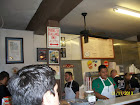
This may not be kosher but anyone who can wangle an invitation to the annual Polenta Dinner at the mother church for Italians in Los Angeles, St. Peter's Church in Chinatown will discover one of Los Angeles' truly undiscovered culinary ecstasies. Screw Ford's Filling Station, Grace, and any "4 star" restaurant in this city, the polenta with sausage and marinara sauce is culinary orgasm, heaping plates full of this and other foods for the price of $25, benefitting the programs at the church. There was so much food left, complete polenta dinners, almost spilling out of their styrofoam containers, were being sold for $5.

Since pizza was the lure to get people to read about Italians in Los Angeles, to all those Easterners and Chicagoans, not to mention the "We Are All Northern Italians" of San Francisco and the good Neapolitans and Sicilians of Chicago: quit your whining and get aboard the reality that Los Angeles has some of the best pizza in the world, even inside Italy.
I can see the thousands of flexed hands flipping me off, Sicilian-style for saying such "heresy" but...................IT'S TRUE.
Pizza, pizza, EVERYWHERE in Los Angeles, and much of it is Italian food esctasy.
GREAT L. A.-STYLE PIZZA:
Michelangelo's Ristorante-www.michelangelo-silverlake.com
Casa Bianca-www.casabiancapizza.com
Petrillo's-www.menuism.com
El Morfi-www.elmorfigrill.com
Tomato Pie (Melrose/Fairfax and Silver Lake)-www.tomatopiepizzajoint.com
Johnnies-a chain throughout Los Angeles, predominantly Hollywood, West L. A., West Valley
Scarantino's Italian Inn-jamesscarantino@gmail.com
GREAT OLD-STYLE L. A. ITALIAN FOOD
Lanza's Italian Market-www.yelp.com/biz/lanza-market-los-angeles
San Antonio Winery-www.sanantoniowinery.com
Palermo's-www.palermorestaurant.net
Scarantino's Inn-www.scarantinos.com
Barone's Italian Restaurant-baronesfamousitalian.com
St. Peter's Italian Catholic Church-italianolosangeles.com
I Panini di Ambra-www.thepaninilady.com
Eastside Market-www.eastsidemarket.com
First and foremost, Los Angeles and Italians go back almost to the founding of the city. Francesco Fiore, a northern Italian vintner, bought land from the Mexican government around what is now Little Tokyo and planted wine grapes. He adopted Mexican citizenship and married into the prominent Coronel family (Antonio Coronel would be the last Hispanic mayor of Los Angeles until Antonio Villaraigosa). Italians married Mexicans in Los Angeles. They did it a lot in 1835 and they do it a lot today.
The Italian-Mexican legacy in Los Angeles is what the Italian-Irish connection is in New York; what the Italian-Polish connection is to Chicago. But, for many recent Angelenos, Mexicans only came to Los Angeles one day before they hired them as nannies, gardeners, and maids.
The Italians were so ingrained into early California and early Los Angeles life that the houses on Olvera Street, the oldest street in Los Angeles were built by Italians. Next time you eat at the ancient Mexican restaurant on Olvera Street, La Golondrina, know that it was the home of one Antonio Pelanconi who built his adobe in 1850. Italians came in large numbers in the late 19th Century and settled along with the Spanish speakers in their own Little Italy, right where Chinatown is today. The Italian Hall was the centerpiece of Los Angeles' Italian community for decades. It is on the corner of Cesar Chavez Ave. and Olvera Street. It's becoming the long-overdue Los Angeles Italian-American Museum. ANYBODY who lived in Los Angeles until 2000 remembers Little Joe's Italian Restaurant. People, even MrLA himself, questioned what an Italian restaurant was doing in Chinatown. The answer is that, at 102 years of age, it was there BEFORE there was a Chinatown. It had unquestionably great Italian food. One thing about the marinara sauces in L. A. Italian restaurants: they are fragrant and tomato soup-like that is unlike any other marinara sauces. Again, the types of tomatoes grown here plus the influence of Mexican cooks, with cilantro, played no small role. Little Joe's outlasted them all the great Italian restaurants of the '30's, '40's, '50's, and on to the present. Say LARUE'S, PERINO'S, PATSY D'AMORE'S, VILLA D'ITALIA to people who remember them and you'll see misty-eyed people who remember their great Italian food and glamour well. Oddly enough, the suburban Italian restaurants survived longer and better than the purely L. A. Italian places:
Petrillos, in San Gabriel and Glendora, since the early 1950's; Casa Bianca, still thriving in Eagle Rock, since 1955; Andre's in the Fairfax Shopping Center, across Farmer's Market, serving Italian food since 1962; Barone's, with three locations in the San Fernando Valley, since 1945. The tasty mini-chain, Tomato Pie, in South Pasadena, Silver Lake, and Fairfax District serve great, diverse pizzas, not to mention the venerable Scarantino's Italian Inn in Glendale, an institution in the Northeast Los Angeles area since 1967.
The two oldest Italian food establishments are still located in Los Angeles in the old Little Italy, which went from Chinatown northeast to Lincoln Heights, off the 5 Fwy. and south of Dodger Stadium. From the 1880's to the 1960's, Lincoln Heights was Little Italy, along with Little Croatia and Little Mexico. There stone houses all over Lincoln Heights, which Italian stonemasons built and lived in. They built 108 year-old Sacred Heart Catholic Church. They built the Di Biasi Building, across the street from the ancient/now hip, slick, and cool Airliner Lounge, where alt and indie rock bands play. MrLA, as a child and teenager, remembers seeing the Frank Pozzo Italian Sausage Company's building right next to the Starlight Movie Theater on North Broadway, the commercial heart of Lincoln Heights.
When Little Italy was at its height (World War I-World War II), there were wineries everywhere. By 1930, with Prohibition having been the law of the land for 10 years, wineries were all but a thing of the past in Los Angeles. The land became too valuable for factories, railroads, and diners to worry about preserving farms on the edge of the Los Angeles River. The San Antonio Winery held on supplying sacramental wine, then (after Prohibition) providing real wine to the Italians and French in Los Angeles (and those that love their cultures). For years, people would ask, "How can that winery still stay in Skid Row and expect to make a profit?" Make a profit it has and under the Riboli Familly, the San Antonio Winery is not only a major historical/cultural landmark, it's a thriving "port of entry" for people who wish to know about wine but don't have the money, gas, nor courage to travel out to the vineyards of Napa, Sonoma, or Temecula Valleys. The San Antonio Winery is the great-grandmother of all the boutique wine shops sprouting all over upscale Los Angeles. Their restaurant serves excellent Italian dishes, naturally paired with their wines. The Riboli Family truly welcomes their customers and sees that you all are treated as extensions of their family. MrLA and his friend, Michael, were unexpectedly given a private tour of the winery simply because they wanted to. Normally, such tours are scheduled far in advance and in large parties but MrLA literally stepped into an equipment check that the vintner (winemaker) for the San Antonio Winery was about to do before the dinner-commuter rush appeared.
If a fancy meal is not your thing or in your budget, turn back on one-block-long Lamar Street from the San Antonio Winery, turn left and half-block to your left, next to a decrepit smoke shop, sits Lanza's Italian Market, on North Main Street, literally a stone's throw east of the Los Angeles River, serving amazing, tasty, meaty, dripping, too-large-for-your-mouth-to-get-around-them sandwiches since 1926. Everything inside the market is time-traveling you to 1926, or at least, 1946. The deli counter looks as if it welcomed Truman on his campaign tour in '48. The sandwiches all come on an L. A.-style Italian bread that you have to taste to understand. MrLA has eaten Italian bread in major Italian-American cities, such as Chicago, San Francisco, and New Orleans but their bread doesn't have that fresh, spongy, doughy, springy, slightly fresh talcum-powder taste that old-time Los Angeles Italian bread has. Lanza's sandwiches are $4.75 and come with pickles so deli, they taste like they came from Canter's on Fairfax, but they didn't :-). The Italian Wedding Soup and Minestrone served there is heaping and cheap at $2.75, an enormous, delicious, satisfying, one-of-a-kind meal that takes you away to another world, a world that only exists at the remaining Little Italy eateries in Los Angeles: Lanza's Italian Market, the San Antonio Winery, and some of the most mouth-watering, gigantic sandwiches created in Los Angeles at the Eastside Market in current Chinatown/Echo Park.
This may not be kosher but anyone who can wangle an invitation to the annual Polenta Dinner at the mother church for Italians in Los Angeles, St. Peter's Church in Chinatown will discover one of Los Angeles' truly undiscovered culinary ecstasies. Screw Ford's Filling Station, Grace, and any "4 star" restaurant in this city, the polenta with sausage and marinara sauce is culinary orgasm, heaping plates full of this and other foods for the price of $25, benefitting the programs at the church. There was so much food left, complete polenta dinners, almost spilling out of their styrofoam containers, were being sold for $5.
Since pizza was the lure to get people to read about Italians in Los Angeles, to all those Easterners and Chicagoans, not to mention the "We Are All Northern Italians" of San Francisco and the good Neapolitans and Sicilians of Chicago: quit your whining and get aboard the reality that Los Angeles has some of the best pizza in the world, even inside Italy.
I can see the thousands of flexed hands flipping me off, Sicilian-style for saying such "heresy" but...................IT'S TRUE.
Pizza, pizza, EVERYWHERE in Los Angeles, and much of it is Italian food esctasy.
GREAT L. A.-STYLE PIZZA:
Michelangelo's Ristorante-www.michelangelo-silverlake.com
Casa Bianca-www.casabiancapizza.com
Petrillo's-www.menuism.com
El Morfi-www.elmorfigrill.com
Tomato Pie (Melrose/Fairfax and Silver Lake)-www.tomatopiepizzajoint.com
Johnnies-a chain throughout Los Angeles, predominantly Hollywood, West L. A., West Valley
Scarantino's Italian Inn-jamesscarantino@gmail.com
GREAT OLD-STYLE L. A. ITALIAN FOOD
Lanza's Italian Market-www.yelp.com/biz/lanza-market-los-angeles
San Antonio Winery-www.sanantoniowinery.com
Palermo's-www.palermorestaurant.net
Scarantino's Inn-www.scarantinos.com
Barone's Italian Restaurant-baronesfamousitalian.com
St. Peter's Italian Catholic Church-italianolosangeles.com
I Panini di Ambra-www.thepaninilady.com
Eastside Market-www.eastsidemarket.com
Thursday, October 28, 2010
The Glory That Was, Is, Still Is, Maybe? Venice, CA


We, Americans! We, of the Walmart ("if it's bigger, cheaper, it's gotta be better") School of Life are the only people who dreamed of taking wonders of the world and copying them in 1/10 the time of the original and build it cheaper in America so that we, Americans, wouldn't have to leave our "bubbles" in life and experience the world: cheaply, safely, and American-ly (aka, "non-foreign", "just like us", antiseptic and conflict-free). America is the capital of the self-created Wonderland. Who else but an American, Walt Disney, would've dared a Disneyland, a self-contained world of worlds past, present, and future, all a 30 minute drive from a Los Angeles suburb and (until recently) worth the price of a ticket (not an airline ticket)?
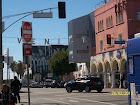
Abbot Kinney, another wealthy American, that's who. Disney was still learning how to draw Mickey Mouse when Abbot Kinney created a wonderland that was so "virtual reality" that it's become it's own wonder of the world. Kinney called it "The Venice of the Americas"; the post office reads, "Venice, California" today. When an Angeleno (like myself) talks of going to Venice, a 20-minute drive down the 10 or the 405 from most anywhere is the longest one has to travel to sample the beach and the freaks on the boardwalk, not the pigeons at the Piazza San Marco nor a villa with the view of the Doge's Palace. Abbot Kinney had other ideas.

Mural of Abbot Kinney, Creator and Founder of Venice, CA
Out of marsh and sand, he used a portion of his millions to build a replica of Venice, Italy. There was a smaller scale replica of St. Mark's Cathedral but what would a Venice be without its canals: At one time, Venice of the Americas, CA had 10 miles of canals built out of the dunes and marsh of the Ballona Wetlands. Just as in Italy, Venice of the Americas had its Grand Canal, with bridges reminiscent of the Rialto. Grand shops lined the new thoroughfares of Pacific and Windward Avenues, leading to the sea, just as the ones in newer, grungier, non-touristy, more deadly suburban sections of Venice, Italy do. Kinney spared little expense in recreating Venice in America but it was definitely an American idea of Venice he created, not the original.
It was the early 1900's when Kinney designed and constructed Venice of the Americas. Like so many of his time and place, Kinney was a strict Protestant who, while he took drinks on occasion himself, was a prohibitionist, blaming drink for the problems of poverty and "moral decay". He was not going to have his Venice serve alcohol, unlike the centuries-old lifeblood of Italy. He was also Utopian, believing that a communal society where everyone knew their place and did their job would create a socially harmonious, dry, heaven on earth where no problems would be easily solved and the residents of Venice would be fed a steady diet of opera, lectures, educational courses, and grand theater. Hey! Sounded like fun..............and it did work for a while,.....................................
but not for long.
Like a good American of his time and place, Abbot Kinney was good at making money. He was one of the major tobacco importers of the United States. When he came to California and slept in the pure(?huh!) air of southern California, his chronic asthma was cured. He bought acreage in what is now Sierra Madre and laid the framework for that city. His wife not liking the area, he went in and bought land that he developed into "Santa Monica Heights". That became the what is now Ocean Park. He, then, bought the marshland that became "Venice of the Americas". Though he tried to make his cultural utopia by the sea, it lost $16,000 the first summer it opened, not in sales of home lots but in attractions. It was then that sword swallowers, three-headed women, and burlesque queens became the cultural offerings for the native and immigrant laborers that Kinney hired to build Venice and live there. Next came the roller coasters and the games where you shoot or throw balls to win and Venice was now like every amusement park in the United States, not a Venice of the Americas, or rather it was, like the Venetian and Bellagio Hotels in Las Vegas reflect the real Italy: sociology as sideshow.
It would be very mainstream media of me if I left out a very important part of Kinney: conservationist. He bought land in Santa Monica Canyon to create the U. S.'s first legally protected forest. He conducted tests to see if eucalyptus trees would grow in southern California. He conducted the first official governmental survey of the Yosemite Valley and also of Sioux villages in the northern Plains. He was on a first-name basis with John Muir and Helen Hunt Jackson, the author of Ramona, a book that practically created Los Angeles but that's another story for another time.
Most of the Venice canals began to stink, just as Kinney's vision of Venice of the Americas did. In 1929, 2/3 of the canals were paved over. The rest were allowed to create small islands of simple two-room cottages where Venice's workers lived. For years, Venice sank deeper and deeper into a pit, both literally and economically. Some of L. A.'s earliest gangs formed in Venice and are still there today. Oil wells churned and spewed gas in the air; transients, prostitutes, and drug addicts were drawn to Venice to enact their own "Summering at the Shore"; cheap rents and cheap people were everywhere. My grandmother reminded me of the rope that divided Venice Beach: one side for whites (the side closest to Manhattan Beach); the other side (closest to Santa Monica) for everyone else.
Starting with Goldie Hawn and Matt "The Simpsons" Groening in the 1980's, celebrities and the wealthy moved into the Venice Canals. True to Venice's own nature, the gangbangers and the poor didn't all go away. They stayed almost side by side with the wealthy new neighbors. The new neighbors didn't go away. Instead, Venice is truly a creation of its own. Someday, somewhere, some 21st Century Abbot Kinney will create a Venice to emulate Venice, CA.
"Baywatch" and every other beach cop show since show the bikini'd rollerbladers and the freak vendors on the Venice Boardwalk. Los Angeles Magazine sings the praises of Rebecca's or Il Pane but the glories of Venice are the way people of different races, classes, life experiences, lifestyles, and jail records all interact and make Venice a fascinating, weird, if not safe place to hang out and live.
Here are current views of Venice: a little, teeny, tiny glimpse of Abbot Kinney's Venice of the Americas, a glimpse of Barrio Venice, and the Venice Canals, in all of their unique beauty.
By the way, don't miss Abbot Kinney Blvd., through the heart of Venice. One of a kind gelato, day spas worthy of the French Riviera (at Barrio Venice prices), Roosterfish (Venice's only gay bar and one of the last reminders of Venice being one of the earliest So Cal communities to be gay friendly), teahouses and art galleries galore, not to mention amazing architecture of various styles, especially taking old, discarded items and fashioning them into stunning buildings. Words alone cannot describe the funky glamour of Abbot Kinney Blvd. or of Venice, California. Come and find your own words!
Subscribe to:
Posts (Atom)