MrLA

Thursday, September 8, 2016

Forgotten But Not Gone!

Unless you work for a state agency, tomorrow will go by unnoticed, not only in Los Angeles but throughout the state of California's cities and towns.  It wasn't always this way.


                                          SEPTEMBER 9 is ADMISSION DAY!


Admission Day?  California is a university student?  a patient needing to go to a hospital?  getting into a 12-Step program?  Uuhhhhh, no.

Admission Day marks the day when California, formerly a Spanish, then a Mexican, province became the 31st state of the United States on September 9, 1850.  California's admission to the Union was a very popular move, except for many of the previously-conquered Hispanic Californios and those U.S. senators who envisioned the lands that the U. S. fought and bought from Mexico as one continental cotton plantation, a slaveholder's heaven.  California's admission into the Union necessitated the Great Compromise of 1850 that soothed slaveholders in the South with more stringent enforcement of the Fugitive Slave Law in exchange for California and the other former Mexican lands, except Texas, to enter the Union as free states.

Statehood was generally favored in Los Angeles, not just from English speakers but many Californios looked forward to gaining greater rights for themselves in the new nation they reluctantly and cautiously belonged to.  Statehood, they thought, would establish their claims to their own land and that the Hispanic Californio culture could continue undisturbed. Sadly, we know how that turned out in later years. 

California was going to be a free state, no matter what.  That same year, 1850, brought about California's commitment to civil rights, beginning the legacy that made California the state that created the 40-hour work week, child labor, allowed women the vote, Cesar Chavez and the UFW, the court cases that first ended racial segregation in the school and workplace and whose outcomes ended those civil rights abuses nationwide.  It was then that, Biddy Mason, a slave owned by a Texan who migrated to California, discovered California was free territory.  She sought a lawyer to demand her freedom through the courts.  After attempts to kidnap her by her former owner, Biddy Mason won her freedom through the California Supreme Court in 1856.  She had relocated her family to California and she began purchasing many lots throughout the city through her work as nurse and educator.  She donated some of her lots to build the city's first firehouse, school, and hospital.  She also became very wealthy in the sale and purchase of land.  She became almost universally loved in the cautiously, defensively multicultural society of the time and was given a funeral worthy of a head of state.

For much of California's statehood, Admission Day was a state holiday, observed by schools, banks, and many other businesses, as well as state offices.  There were parades in major cities celebrating Admission Day well until the 1970's.  I remember well getting that day off, often three days into the new school year.  

                            WHY DON'T WE CELEBRATE IT ANYMORE?

The answer is "I don't know." I could offer a number of theories but that's all they would be.  Certainly, the state's ever decreasing general funds phased out the civic parades that were so often found in cities, especially on Admission Day.  Also, educators and civic leaders have "dropped the ball" in promoting and publicizing Admission Day to newer generations, ignoring it's importance to all Californians.  Newer arrivals into California don't know of Admission Day. Since few apprise them of the holiday, Admission Day has entered the Twilight Zone of formerly important holidays, such as Arbor Day, May Day, and Flag Day.  Like the others, California's Admission Day deserves the pomp, festivities, and celebration that the state deserves.  After all, 37 million people call California home, more population than any other state in the United States.  It's economy ranks as the 12th largest in the world. It is home to the most ethnically diverse population in the western United States and it all began on September 9, 1850. 

Admission Day must become a reminder of how our great state came to be and how we shape it with our presence here every day!
Plaza de Los Angeles, where news of California's admission to the Union was read.


Los Angeles, 1848, newly American but not yet a state

Biddy Mason Park, Downtown Los Angeles
Biddy Mason Park, 300 Block, Broadway, across from the Grand Central Market
A quiet, beautiful place to meditate, relax, eat, right in Downtown Los Angeles, Biddy Mason Park


                                                 ADMISSION DAY, SEPTEMBER 9


Thursday, May 12, 2016

Los Angeles Under The Radar: Charles Lummis, the first Mr LA!

For so many people in and out of Los Angeles, Los Angeles conjures up images of objects and foods Latino.  When many people think of California overall, California's Missions often come to mind and are visited annually by millions from around the world.  In and out of Los Angeles, AAA (more often than not known by it's nickname: the Auto Club) plans the trips and makes travel far more pleasant for millions all over the United States.  President Obama and thousands of others attended Occidental College, one of the most prestigious institutions of higher learning  in the United States, located in one of the trendiest neighborhoods in Los Angeles, Eagle Rock.  The Los Angeles Times is one of the leading newspapers in America and is an icon of Los Angeles.  What do all of these have in common?      Him below
Charles Lummis


Charles Fletcher Lummis, though born in Lynn, Massachusetts, left such a wide and varied mark on the city of Los Angeles that one could say he, singlehandedly, created the city of Los Angeles.  He was the first MrLA!!!


Suffering from a respiratory ailment, Lummis was advised, as was the medical practice of the day to treat respiratory diseases, to move to a milder climate.  Always possessed by an intense spirit of adventure, the 28 year-old Lummis chose to go to Los Angeles and skipped going by train to L. A. 

HE WALKED THERE!  It took him two years to reach Los Angeles!   He was stranded in northern New Mexico by the winter snows of 1884.  While there, he lived among the Pueblo, came to love their culture, and saw the firsthand degrading attempts by the U. S. government to eradicate their culture so that they could fully emulate Anglo America.  He became one of the most ardent supporters of Native American rights as well as one of the earliest exponents of  Native American cultures to a mainstream American public.  His collection of Native American artifacts, especially rare pieces from Californian nations, became the Southwest Museum, in Highland Park, still the largest and most comprehensive museum dedicated to Native Americans in the United States. 
Southwest Museum

He became friends with a journalist, Helen Hunt Jackson, when he arrived in Los Angeles in 1885.  He had been so passionate to her describing the cultural traits and mistreatment of the Pueblo Indians that Mrs. Jackson, likewise a supporter of Native American rights, determined to change U. S. government treatment of Natives by writing a book, Ramona, which became one of the best-selling American books ever but backfired in rousing the U. S. government from treating Native Americans as fellow citizens.  It did, accidentally, lead to the turning of Los Angeles' (and California's) history of Spanish settlement into a billion-dollar industry, which Charles Lummis wasted no time in exploiting for his pet projects and self-promotion.


When Lummis arrived in Los Angeles, although he was hired to become the Los Angeles Times' first city editor and wrote articles for publication in this fairly-new newspaper, including an interview with famed outlaw, Frank James, while he walked to Los Angeles, he arrived at the Los Angeles Plaza almost dead from exposure, hunger, and exhaustion.  A few months after assuming his duties at the Times and living two doors down from what is now the Grand Central Market, he suffered a stroke at age 27 that left him paralyzed on one side.  He fled Los Angeles back to the Pueblo Indians and divorced his first wife. during which time he exercised his way back to full recovery.  His experiences there not only led to regaining his health, he met and married his second wife at a Pueblo reservation in New Mexico, he wrote essays that he collected and published nationally.

Pomo Basket, Southwest Museum

In 1892, he returned to Los Angeles with his new wife and daughter.  His essays were  now netting him riches and national recognition.  His love of the early Spanish history of California led him to take photos of early California buildings for the club he founded, the Landmarks Club, and it's magazine, Out West.  The Landmarks Club gained hundreds of members over the next 10 years, enthusiastic to preserve California's Missions and Native Californian cultures.  His maps for owners of those newfangled automobiles to visit the missions and other California landmarks made the Missions made them accessible to countless people, turning them into some of California's and America's most famous tourist destinations.  Their fame led to the state and federal governments restoring the missions to their original forms and turned into state historic parks, protected and preserved for future generations.   The club grew so large that it became known as the Automobile Club of Southern California and, later, the American Automobile Association.  It's magazine, Sunset Magazine, is still one of the leading sources for tourism in Los Angeles and Southern California.
Santa Barbara Mission, Made Famous by Lummis' Landmarks Club, now AAA

Mission Bell Landmarks Lobbied by Lummis for Visitor to Easily Find and Tour California Missions

San Fernando Mission, New Year's Day, 2015


Lummis' ever-growing collection of Native American artifacts grew as he traveled to other areas of the United States, Mexico, and Guatemala.  To house them and to further get American public opinion to respect and value Native Americans, Lummis founded and raised funds to build the Southwest Museum, still towering almost like an Italian hilltop palace overlooking Highland Park and the Arroyo Seco. 

Highland Park became Lummis' home for the rest of his life.  Not only did the Southwest Museum come into being through his efforts, he led the creation of Occidental College in 1913, from the beginning, one of the most prestigious private colleges on the West Coast, traditionally famed for its writing, pre-law, and political science programs, makers of many careerists in the U. S. State Department, Oxy, as locals call the college, graduated President Barack Obama. 


Hohokam Fetish, Southwest Museum


Occidental College


By this time, Lummis was on a first-name basis with luminaries of the late 19th-early 20th Century, such as John Muir, Theodore Roosevelt, Ethel Barrymore, Enrico Caruso, and the Duke of Albuquerque, representing King Alfonso XII of Spain, among many others.  They not only knew Lummis, they visited and often stayed at the home he built on the banks of the Arroyo Seco, just after recovering from blindness caused by jungle fever on a trip to Guatemala.  From 1897-1910, he built the two-storey home himself from river rock and trees along the Arroyo Seco. He christened his home, El Alisal (The Willow Tree, in Spanish), and entertained these and other luminaries for the next 30 years.  Today, it's a museum with Lummis' furnishings, writings, and personal artifacts, facing off to the 110 Fwy. and Heritage Square Museum.


El Alisal, Lummis' final home, in Highland Park

As celebrated as Lummis was in his day, he underwent a steady decline in his health, fortunes, and personal life.  With most of his money gone, his eyesight gone, and his third marriage dissolved, Lummis lived off of lectures until his death in early 1928.  He arrived in a small, dusty Western town of 12,000 in 1885 and died when Los Angeles had reach 1,000,000 inhabitants. 43 years later.  He played NO small part in creating the Los Angeles of today.  In a world where news media can devote weeks to a four-letter word by Kanye West and its fallout in the music industry, it is criminal that the City of Los Angeles, that received and benefits so much from the work of Charles Lummis, lets him be unknown and insignificant in the lives of Angelenos. 


Since 2006, residents of Highland Park commemorate Charles Lummis and all that he achieved in Los Angeles by hosting a weekend Lummis Day Festival, featuring music, readings of Lummis' work, food, and visits to the Highland Park institutions Lummis founded.  This year, it begins in the afternoon on Friday, June 3-Sunday, June 5, 2016 in different parks in Highland Park. MrLA will be commemorating his own 1-year anniversary by taking visitors to enjoy, experience, and savor the life, accomplishments, and legacy of Charles Fletcher Lummis with a 4-hour tour beginning at the Los Angeles Plaza, next to Olvera Street and returning there, with travel to Lummis sites by way of the Metro Gold Line. For more information, visit:  www.mrlatours.com or call (323) 452-2743.


Do what you can so that the original Mr LA, Charles Foster Lummis becomes as loved, respected, and sought out as any entertainment personality or L.A. Live!
fi


Tuesday, May 3, 2016

Los Angeles Under the Radar: South Figueroa Corridor, Part 1

Today, I went on a tour of a landmark that is not only one of the most famous buildings in Los Angeles, it is one that has displayed Los Angeles on film for a world audience on many occasions.  This landmark is the only one to have done this one thing:  host two Summer Olympic Games.  By this time, you know I'm referring to the Los Angeles Memorial Coliseum.  I've been one of those people suffering from what I call "The Disneyland Syndrome":  those people who grow up in the shadow of a landmark yet wait until middle age before visiting it.  I saw the Coliseum, like many do, as merely an aging, out-of-date, stadium that is increasingly forgotten.  Many people, I'm sure don't even know it exists, so long has it been out of the general L. A. consciousness although the Coliseum is the home of the USC Trojans.  As the Coliseum Tours tour I took points out, it is SOOOOOOOOOOOOOOOOOOOOOOO much more!

It is the home to one of only three cities in the world that have hosted more than one Olympic Games (1932, 1984, and, if given the games, in 2024)!  It was Knute Rockne's first college football coaching before he went on to glory at Notre Dame!  It was the first home of the Los Angeles Dodgers, after Brooklyn, before Dodger Stadium, and home to the first three World Series titles the Dodgers played in their first five years (they won in 1959!)!  It is the oldest multipurpose sports stadium complex in Los Angeles! Although this has some negative history attached to it, the Los Angeles Coliseum is the prototype that cities since the 1932 Olympics have used in designing their stadiums in subsequent Olympic Games, starting with Adolf Hitler's designs for his 1936 Olympic Games stadiums.  So, when one thinks of Olympic stadiums, the Los Angeles Coliseum created the image!  The Coliseum Tour takes you into virtually every nook and cranny of the Coliseum that includes the locker rooms that have been used by the Dodgers, Rams, Raiders, as well as the Bruins and Trojans.


As if the Coliseum were not fascinating and worth a tour lasting hours all on it's own, it is part of the complex of buildings in Exposition Park, one of Los Angeles' oldest parks and home to some of Los Angeles' iconic features.  such as the Los Angeles Museum of Natural History, the California Science Center, as well as one of the most beautiful rose gardens in the United States, Exposition Park and the Coliseum make the southern end of one of L. A.'s most interesting and quickly-changing neighborhoods:  South Figueroa Corridor.
Los Angeles Coliseum
One of the Greatest Stadiums in the World-Home to Two Olympic Games


St. Vincent de Paul Church, Adams & Figueroa

While this sounds sterile and industrial, there is sooooooooooooooooo Whmuch to see and do that taking in the sights, smells, foods, galleries, architecture, and communities would take a week to calmly and completely experience.  It is that packed with places to see and things to do within the 2-mile stretch of South Figueroa Street starting at L. A. Live on Olympic Blvd. and ending at Exposition Park and the Coliseum.  While everything along the corridor can be reached by car for a quick drive-by, the vivacity, color, and incredible cultural/architectural wonders really reveal themselves in a comfortable 4-hour walk or by getting a Metro TAP Card for $1.00 plus a $7.00 Metro Day Pass paid on the TAP Card to use the Expo Line and comfortably visit the entire corridor.  Stay tuned for more to see on the South Figueroa Corridor and why you'll get to spend a wonderful day visiting it and feeling as if you saw all the sights of Paris, London, Rome or any other great city in the world.
Murals alongside L. A. Live
Entrance to Patriotic Hall

                                                       
South Figueroa Corridor Across from L.A. Live and Staples Center
Revolutionary War Mural at Entrance to Patriotic Hall

Monday, March 28, 2016

Los Angeles Under The Radar: The Sierra Pelona American Viticulture Area, 40 Minutes from Downtown Los Angeles!

Time flies when you're out and about and experiencing Los Angeles, as MrLA does.  I conducted a tour of the Los Angeles Wine Country, largely unknown to Angelenos themselves, on March 19.  I know that my last posts have all been about and make me seem to be a paid spokesperson for Los Angeles-area wineries but I keep discovering far more wineries, with their respective vineyards, like Napa Valley, within a 45-minute drive from DTLA.  From the venerable San Antonio Winery, often the only winery many Angelenos know, to the Joseph Filippi Winery in Rancho Cucamonga (one of the oldest wineries in Southern California with a few of it's original vineyards growing grapes that produce their delicious wines) to the Reyes Winery in Santa Clarita, not only one of the new breed of wineries creating this Los Angeles Wine Country but growing grapes in landscapes that resemble Napa or Sonoma wineries,  five local ladies enjoyed visiting and tasting wines from our local lands, along with MrLA and Giovanni, whose van drove us comfortably and safely to these locations.

When we arrived at the Reyes Winery, MrLA discovered that not only were there 40 different wineries, vineyards, and tasting rooms in the recently-created Sierra Pelona American Viticulture Area, those entities will be gathering on April 23 to promote their wines and foods while raising funds for the programs of the Santa Clarita Valley Center.  More about that in an upcoming post.

I had the marvelous opportunity to speak with Robert Reyes, the owner of Reyes Winery, and Beth Bode, marketing director for the winery.  They informed me how a burgeoning number of wineries and vineyards had sprung up so abundantly throughout the area from Santa Clarita to Acton, among the Sierra Pelona Mountains, north of CA Highway 14, that local winemakers petitioned the U. S. Treasury Department in 2009 to create a new AVA (American Viticulture Area), recognizing these establishments as wine producers.  On August 23, 2010, the Sierra Pelona American Viticulture Area became the first such area in the Los Angeles region since the 1880's!  Yet, most of these and other local wineries remain virtually unknown, "under the radar", to most Southern Californians.  As I've mentioned in my other wine-related posts, there is no reason for Angelenos to put $50.00 of gas to travel hours to other wineries when $50.00 will get you tastings at two Los Angeles-area wineries, plus gas, an inexpensive meal, and vistas that rival Napa and Sonoma for beauty!

At nearby Agua Dulce Winery, one can sip wines and stay in sumptuous accomodations in a home resembling the White House than an inn.  In the heart of the Sierra Pelona AVA is Le Chene, a new and increasingly popular French restaurant which, naturally features wines from local wineries.  The connection with local wineries is so close that Reyes wines can be bought at the Reyes Winery, taken to Le Chene, opened without a corkage fee, AND accompany a meal that will be discounted by 15% simply for having bought and opened a Reyes wine.  While this might not be St. Helena and the French Laundry, Southern California's version is fantastic and worthy of being mentioned in the same breath with other such winery-restaurant pairings in other wine countries. 

Join me and other explorers of Los Angeles: Under the Radar as we explore the Sierra Pelona AVA and its wineries as we attend an upcoming festival featuring the wines of the area and excellent foods to pair them with.  Stay tuned for more information on this wine festival on Wednesday!


Reyes Winery
10262 Sierra Highway
Agua Dulce, CA 91390
(661) 268-1865
www.Reyeswinery.com


Agua Dulce Winery
9640 Sierra Highway
Agua Dulce, CA 91390
(661) 772-0145
www.aguadulcewinery.com


Le Chene
12625 Sierra Highway
Agua Dulce, CA 91390
(6610 251-4315
www.lechene.com


Approach to Reyes Winery
Entering the Reyes Winery
MrLA with Robert Reyes
MrLA with the Lovely Ladies He Toured With

Agua Dulce Winery and Inn

Chardonnay Harvest at Agua Dulce Winery

Tasting Room at Agua Dulce Winery
Fermentation and Aging Room-Agua Dulce Winery


More than 40 Wineries Within 40 Miles of Downtown Los Angeles! Find Out Where!More Than 40 Wineries Within 40 Miles of Downtown LA. Find Out Where!

Wednesday, February 17, 2016

The Best Things in Los Angeles are...........UNDER THE RADAR!

Being a lifelong Angeleno, I've come across people who fall into 3 categories (how Virgo of me! -):

1.  Those who come to Los Angeles for film, tv, and music fame, who start living and leaving the "Glamour Ghetto" ( La Brea Ave. west to the Pacific Ocean; Burbank west to Woodland Hills), believing this is Los Angeles and it conforms to the images on tv that they see (made by men and women who live and work in the Glamour Ghetto). To these people, "Downey" and "El Sereno" are places on Jupiter, as far as they're concerned;

2. Those who are born and raised in Los Angeles but live their lives in a limited circle and are not usually tuned into the artistic or cultural events going on in the city; AND

3.  Immigrants who, by virtue of their newness to not only to Los Angeles but to the United States, are clueless or are uninterested in that that makes the city unique.  Their world is that of survival and safety, physical and cultural, having others from the same country and/or ethnicity as they are.

The vastness of Los Angeles exacerbates the tendency of all three groups to not seek out or who remain unaware of the historical, cultural, artistic, and ethnic richness that are unique in the way they play out in the daily lives of Angelenos.  I first was clued to that richness when the 1984 Olympics were held in Los Angeles.  The Olympic Committee created the Olympics Arts Festival, which, for those of us who experienced it, was the first time Angelenos came from all over, put their fears and prejudices aside, got their "adventurer" on, and discovered that this vast city was really a larger village with "villagers" coming from different countries, different regions of the U. S., mixing with those who were born or lived much of their lives in Los Angeles.  I attended the Soccer Semi-Final match between Morocco and Brazil as well as a fashion show of Middle Eastern fashions at Al-Amir, a long-closed Lebanese restaurant next to E Entertainment on Wilshire Blvd.  I went to two free Shakespeare plays and Spanish tabla dancing in Griffith Park.    Every day, in the Los Angeles Times and the Los Angeles Herald-Examiner published the daily and weekly listings of the Olympic Arts Festival.  It was the first time in my memory where the city was alive in the way Rio is during Carnival.  It was the first time I felt that I was in a brother- and sisterhood with people I'd shied away from knowing.  That was one of the singular moments of my life.

I will be highlighting areas that not only continue to be this eclectic in their ethnic makeup but eclectic in their art, music, food, and their relations with their neighbors.

Stay tuned for further entries into "L. A. Under the Radar"!

Thursday, January 14, 2016

The City of Angels and its Angelic Wines!

Wines!  California Wines!  The world over,  images of vineyards bring about vistas of Mediterranean-style landscapes studded with luscious acres of multiple-colored grapes rolling over hills and valleys, with vineyard owners and guests enjoying a Tuscan meal of cheeses, fruits, and wines made from the luscious grapes, looking out over a veritable Garden of Eden of wine grapes.  Where is this heaven on Earth?  Many people would say "Napa Valley"; others would say "Sonoma"; others might say "Temecula".  "Los Angeles". Whoaaaaaaaaaaaa!  "Los Angeles"?  Wine shops, maybe but winemaking?  The second largest city in America!  More cars in traffic than there are people in California?  There are no vineyards or wineries in Los Angeles.  WRONG! Not only is Los Angeles home to some of the newest wineries in the United States, there would be no American wine industry without the wineries first founded in Los Angeles, almost 200 years ago. 

Everyone remembers the Pilgrims, those disgruntled English people who gave us Thanksgiving, the Mayflower, and unhealthy notions of sex, liquor, and love.  They actually made great beer and they attempted, many times, to make wines out of native New England grapes.  They failed.  Those grapes produced sour wines or wines that tasted like raw maple syrup.  After a few years, the Pilgrims gave up winemaking and did what they did best:  tell other people how to live their lives.

A hundred and fifty years later, Spanish missionaries brought the first wine grapes to California, which is where American wine history was made.  Like most of the people the Spanish missionaries served, the wine grape brought to California was a hybrid of grapes from different breeds and mixed in Latin America.  Spain owned much of Italy for 250 years.  One of the Italian grapes, the Minorca, made the trip to the New World and mixed successfully with native Mexican, Chilean, and Argentinian grapes to form another variety, known as the Criolla (Kree-oy-a).  The Criolla came to California and, because of its association with the Spanish missionaries, it became known as the Mission Grape.

Although the first recorded harvest of grapes and California winemaking occurred at Mission San Juan Capistrano, it was at the San Gabriel Mission that winemaking became a California industry. 
The climate in the San Gabriel Valley proved ideal for the Mission Grape.  The San Gabriel Mission produced more grapes and wine than the other 20 missions in California.  Often, wines from San Gabriel were CARE packages to other missions not able to grow as many grapes or make as much wine. Although the wine was to be used only for the Catholic Mass, so much wine flowed from San Gabriel that the missionaries developed a nice business selling wine to soldiers, their wives, and other colonists living nearby.

A few years after San Gabriel Mission was founded, King Charles III of Spain ordered an actual town be founded near San Gabriel to bring more Spanish colonists that would protect Southern California from those evil English and Russians (in the mind of King Charles, at least) to take away California from Spain, as Spain did to the Native Americans.  When that town was founded in 1781 with the name of Nuestra Senora la Reina de los Angeles de Porciuncula, not only did that town grow up to be Los Angeles, the San Gabriel missionaries gave the people of Los Angeles a house warming gift.  Guess what that was?  Mission grapes.  You can imagine what happened then!

The Mission Grape grew more abundantly in Los Angeles than even at the San Gabriel Mission.  There seemed to be more wine bottles per inhabitant than tortillas.  As many of the residents grew wealthy, people with last names such as Verdugo, Sepulveda, and Dominguez added their private vineyards and wineries to their sprawling ranches.  There is something inevitable about Los Angeles and liquor that Jose Maria Verdugo's private winery from 1795 stood where today's insanely popular Golden Road Brewery brews beer near the Los Angeles River, in Glendale.

It was only a matter of time that wine in Los Angeles went from private to commercial.  A gift by priests at Los Angeles' mother church, Our Lady Queen of Angels, awarded some of its vineyards to its first Yankee American resident, Joseph Chapman, as a thank you for building the church.  In 1824, Chapman opens the winery later known as Chapman & Sons on that site, the first commercial winery in the United States. 

Under Mexican rule, Los Angeles attracted hundreds of French and Italian immigrants, many of whom grew grapes, made wine, and sold them profitably.  After Los Angeles became American, many Croatian, German, Austrian, Greek, and Chilean immigrants opened wineries, making Anaheim and Cucamonga the premier wine producing regions of the United States for the latter 19th and early 20th centuries. Southern California grapes even saved worldwide winemaking when Cucamonga Mission grapes were the only ones resistant to the deadly (and decimating) phylloxera, almost making winemaking extinct. These local grapes saved the day for all of us to enjoy our California wines.  There were 165 wineries in Los Angeles County alone.  Where did they go?  Why don't we see them today

Los Angeles marketed itself all too well as a Garden of Eden.  Millions have made Los Angeles city and county home.  Land companies made millions, too:  millions of dollars buying vineyards and wineries, turning them into office buildings, tract homes, freeways, etc. Only the J. Filippi Winery in Rancho Cucamonga and the San Antonio Winery in Downtown Los Angeles remain from the original glory years of Los Angeles winemaking.

Good news!  Los Angeles winemaking has made a major comeback only it is of the "less is more" variety.  There are a dozen "microwineries" within a 45-minute drive from Downtown Los Angeles.  These started out as "toys" of financiers who wanted to be winemakers so they bought existing or planted new vineyards that produced such good grapes that the owners built wineries and tasting rooms to publicize their new wines.  Unlike J. Filippi or the San Antonio Winery, microwineries like Rosenthal (in Malibu), Cornell (on Mulholland Drive in Agoura Hills), and the Reyes Winery (in the shadow of Vasquez Rocks, outside of Santa Clarita) plant small batches of grapes and bottle small batches of wine.  Cornell and Rosenthal are selling limited numbers of bottles in Los Angeles area wine shops but the best experience, the true L. A. winemaking experience as the Verdugos, Sepulvedas, and other early iconic families did:  out in the open, at a winery, next to the grapes that produced them. 

Mr LA Tours had such great success with its first bus tour taking adventurers to three local microwineries that, by popular demand, the next  motor coach/bus tour, Valentine to LA Wineries Tour, will start and end at the granddaddy of L. A. wineries, the San Antonio Winery, on Sat. April 2, 2016, from 10 a.m.-4:00 p.m.  Visit:  www.mrlatours.com for more information or call (323) 452-2743 for more details.


Tuesday, October 27, 2015

Oy, Caramba! Mexicans and Jews Get Together in L. A. Boy, Did They!

Los Angeles has more Mexicans than any other city outside of Mexico.  Los Angeles has the second largest Jewish population in the United States and the fourth largest in the world.  Yet, Angelenos and people outside Los Angeles don't even bat an eyelash in linking Mexicans and Jews in Los Angeles.  The only thing more under the radar than that are insects splattering on car windshields during the summer.

Having both Mexican friends and Jewish friends in L. A., also having dated a few Jewish women back in my 20's, there is seeming almost-total disconnection between the Mexican communities of largely the Eastside, South Central L. A., and the East Valley and the Jewish communities of the Westside and Southeastern San Fernando Valley.  To the casual observer and to many Angelenos, the two communities mix, at best, between Spanish-speaking help and Jewish homeowners.  One might as well be talking of Venus and Mars as of Jews and Mexicans, for the amount to which both groups are aware of each other in L. A.


What older Mexican-Americans and Jewish-Americans who were born and raised in Los Angeles know is the strong though unpublicized bond that has existed among Mexicans and Jews since Los Angeles (and California) was part of Mexico.  It's still hard for most Americans to wrap around their heads that Jews played a significant role in the settlement and development of the American West.  Yes, there were Jewish cowboys driving cattle, many more than the history books and Western movies would tell us.

Jacob Frankfort was the first recorded Jewish person to arrive in the Mexican town of Nuestra Senora la Reina de Los Angeles de Porciuncula (L.A.) in 1841.  He stayed long enough to become one of the wealthiest men in that tiny town by the time the U. S. took over in 1847.  He went aboard the Peruvian ship, Ascencion, in 1845, docked in San Pedro Harbor, to appraise the ship's contents.  He was sent by the mayor of Los Angeles.  Frankfort knew enough Spanish by then to do his job.  That set the pattern for Mexican-Jewish relations for the next century.

This is the Los Angeles that Jacob Frankfort lived in, 1848, one year after Los Angeles became the United States.


There were eight Jewish inhabitants in Los Angeles in 1850, when California became a state and the American city of Los Angeles was created.  One of those eight, Morris Goodman, became one of the first city councilmen.  He started a tradition that continues today, with councilmembers Paul Koretz, Mitchell Englander, and Bob Blumenfield.


As the city grew, so did the Jewish population.  Because the city maintained a Spanish-speaking majority population until the 1870's, Los Angeles' Jewish community knew Spanish and catered most of their business to the Mexican community.  This would also occur into the 20th Century with Jewish storeowners, bankers, and other professionals becoming immersed in Spanish-speaking communities and offering their services, often in Spanish. Some of the new Jewish arrivals, such as Joseph Newmark, came to Los Angeles in 1854, made great wealth in  farming and ranching, adopted the Spanish Don lifestyle that his neighbors, the Picos, Sepulvedas, Carrillos, and Verdugos had lived. He built an adobe that stood until the 1930's and became the founder of Montebello and his land became Monterey Park.  His and other Jewish families were so integrated into Los Angeles culture that Harris Newmark's "My Sixty Years in Southern California" is considered one of the essential histories of early Los Angeles. 

The leading Spanish-speaking Californio families enjoyed close relationships with many of their Jewish neighbors.  MrLA was astounded one day when, on a tour of the Casa de Adobe in Highland Park, a replica of a typical Californio mansion of the Spanish/Mexican era, a 60-ish woman and her husband were talking about how the wife remembered seeing furniture and cowhides at her Uncle Antonio's house.  In conversation, she told me that she and her husband were from one of the oldest Jewish families in Los Angeles.  Who was Uncle Antonio?  He was Antonio Sepulveda, of THE Sepulvedas, of Sepulveda Blvd. fame.  Her father worked for Antonio Sepulveda.  Her family and the Sepulvedas were so close, she called Antonio "Uncle Antonio" and grew up visiting him at his ancestral adobe near Culver City. 

Yes, most Mexicans were staunchly Catholic and Jews were Jewish.  Anti-Semitism was always present in Los Angeles although, among Mexicans, it was never serious enough to prevent close friendships from happening or preventing both groups from living next to each other. It was only dating and marriage between them that proved a consistent conflict between Mexicans and Jews.

 For much of L. A. history, little was known of Mexican-Jewish intermarriage. Publicly, such unions were discouraged although there were certainly such unions, whether they were official or unofficial unions.  Particularly among Jews, intermarriage was seen as threatening the existence of Judaism.  Nonetheless, as the years rolled on, with greater numbers of Mexicans and Jews living next to each other and going to schools together, there would be romances and, extremely so, marriages.  MrLA was a teacher's assistant at a Hollywood elementary school in the early 1980's, putting himself through  college.  He met an older woman named Dolores, who grew up in the San Fernando Valley but was the daughter of a man and woman who grew up, met, and married in Boyle Heights.  The father was Mexican-American; the mother, Jewish-American.  Dolores told me how her father, a dark-skinned man and her mother, fair-skinned, would not be served in some restaurants in Los Angeles during the 1940's and both families practically disowned them.  Despite those and many other bigoted slights, including living Mexican/Jewish in a mainly WASP San Fernando Valley in the 1950's,  Dolores' parents remained married, had children, knew their grandchildren, and both families eventually came to accept their marriage.  MrLA worked as an elementary teacher in his other lifetime.  He was friends with a group of female Jewish teachers who married Mexican-American and other Latino men.  These ladies spoke fluent Spanish and were as at home on the Eastside as they were on the Westside, where they were raised.  One of MrLA's classmates when he was being certified as a teacher was a woman named Carole, who was from one of the many Jewish families living in Baldwin Hills in the 1960's who married an African-American classmate  from Dorsey High School.  It might not have been the "epidemic" that the Jewish community in Los Angeles might've thought but there was a lot of mixing going on between Mexicans and Jews in L.A.  Like a lot of romantic/sexual activity that is frowned upon by mainstream society, Mexican/Jewish unions were quietly, sometimes, anonymously entered into, sometimes kept on the down low but they happened and happened more often than Angelenos then and now might've realized.

Sephardic Jews are Jews that trace their ancestry to Portuguese and Spanish Jewish communities that existed before they were destroyed by the kings of Portugal and Spain in the 1490's.  Like Gypsies, they scattered to many countries around the world.  Many would make their way to Los Angeles from the 1850's onward. It could be said that Los Angeles' Sephardic Jews were the bridge that made contact between Mexicans and Jews so easy in Los Angeles. S. K. Labatt and Solomon Lazard were two of the earliest Sephardic Jews in Los Angeles.  Not to diminish the contributions of other Jewish communities but the Sephardic community not only influenced the pattern of relationships between Mexicans and Jews in Los Angeles, they left a gigantic imprint on Los Angeles institutions WAY beyond their numbers.  Sephardic Jews speak Ladino, a language that is largely 15th Century Spanish mixed with some Hebrew and words from Middle Eastern countries  where Sephardics went after their communities in Portugal and Spain were destroyed.  Speakers of Spanish and Ladino speak to and understand each other very easily.  S. K. Labatt and Solomon Lazard came to Los Angeles and set up shops, selling to the largely Spanish-speaking Angelenos of the 1850's.  They communicated with their neighbors easily and became friends as well as business associates of both the Latino Californios and later arrivals of Jewish with non-Hispanic backgrounds.  It was Labatt and Lazard that started the first Jewish organization in Los Angeles, The Hebrew Benevolent Association.  Among it's achievements was the creation of the first Jewish cemetery in Los Angeles. Located in Chavez Ravine, there's a marker nowadays that marks the site of that cemetery.  In 1910, the remains in that cemetery were moved to other, newer Jewish cemeteries in Boyle Heights and East Los Angeles. 
Marker Showing Site of the First Jewish Cemetery in Los Angeles


The Hebrew Benevolent Association later created the first synagogue in Los Angeles:  B'nai Brith.  It continues 153 years later as the Wilshire Boulevard Temple on the Miracle Mile, one of Los Angeles' landmarks and home to many celebrity weddings over the years.


Solomon Lazard and the Legacies He Left.


Into the 20th Century, Labatt led the way to the creation of two of Los Angeles' iconic hospitals:  Cedars-Sinai Medical Center and City of Hope. 


Those few of us Angelenos left who grew up in Los Angeles between 1910-1960 remember Boyle Heights as the center of the Mexican community, the center of the Japanese community, the Russian community, the Croatian community, an important African-American and Italian community and, most definitely, the center of the Jewish community.  Synagogues, delis, day schools, and Judaica would be found throughout Boyle Heights.  Next to the Lower East Side of New York, more Jews lived in Los Angeles than any other city.  The community life within the Jewish community was strong. Doctors, lawyers, teachers, political activists came out from Boyle Heights.  So did Mickey Cohen and Johnny Stompanato, two of the most infamous gangsters in American history.  All her life, Cohen's housekeeper mother would say her son was a good boy, after arrests but the Jewish community of Boyle Heights was one of the first to call President Franklin D. Roosevelt to increase immigration for Jewish refugees fleeing Nazi Germany; call for the creation of Israel; fight to end racial discrimination that kept African-Americans east of Alameda Street and South of Downtown by law; loudly called to end the illegal mass deportations of  Mexicans and Mexican-Americans to Mexico during the Depression, etc.  It was in Boyle Heights that Alice Greenfield McGrath grew up among Mexicans. Her familiarity and ease with Mexican culture permitted this Jewish woman to raise money for the defense of 12 Mexican-American youth charged with a murder that they didn't commit at a water pit sensationally called "Sleepy Lagoon", a murder case that, along with the Scottsboro Boys, became a hallmark of racism in the American legal system that became the basis for the famous play and film, "Zoot Suit". 

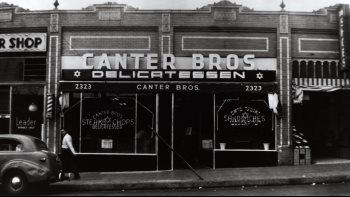
The business and community life in Boyle Heights was a kaleidoscope of cultures and great activity.  Anyone remember seeing Dr. Cohen, the credit dentist, whose Downtown L. A. and East L. A. offices catered heavily to Spanish speakers?  He did tv ads on KMEX-TV, Channel 34 until the early 1970's. Canter's Deli, the home of hipsters and Hollywood A-list wannabes didn't start life on Fairfax.  It started on Brooklyn Avenue in 1931.  There are generations, now graying, that remember Zellman's on Brooklyn Avenue (now Cesar Chavez Avenue but named for many Jewish residents who migrated from New York to Boyle Heights in east Los Angeles) and Manny Zelman, the last owner of the store, rooted in Boyle Heights until his was the only Jewish-owned store left in Boyle Heights. Manny and his son, Dean, closed the store in 1999 but Dean Zellman stayed on in Boyle Heights' Neighborhood Council. 

If there was such a historic bond between Mexicans and Jews in Los Angeles, why don't we, Angelenos, see that, hear about it, read about it?  Why does no one no about it?

After World War II, soldiers of all kinds were offered the G. I. Bill of Rights.  They came back from
the war empowered to do things they would not have had the idea  nor the money to do, such as buy homes.  With the end of racial covenants in California, which allowed legal segregation by giving homeowners rights to refuse to sell to non-whites and non-WASPs, Jews, Mexicans, and African-Americans could move to the new housing developments.  Jews moved out of Boyle Heights to the Fairfax area and the Westside, generally.  Mexican-American veterans and their families moved eastward and southward into housing developments in Pico-Rivera,  Montebello, Commerce, Downey, and Paramount, among others, creating not just a physical distance but a physical and cultural divide so great that future generations of Mexican- and Jewish-Americans no longer interacted nor knew of each other. The younger generations of those groups are not, generally, conscious of each other's existence, as their grandparents had been.

As those families left Boyle Heights, a steady, constant stream of Mexican immigrants used Boyle Heights as a "port of entry", their place of settlement after arriving from Mexico.  So, for generations, Boyle Heights was all but turned into a Mexican city.  The poverty that comprises much of the Boyle Heights community and media focus on gang crime in the area have, until the last 5 years, stigmatized Boyle Heights, causing Westside and Valley Jews to not see any need to visit Boyle Heights, viewing the community as threatening and the Boyle Heights community viewing the Jews with suspicion and bewilderment.

Since World War II, waves of Jewish migrants from other American cities and Jewish immigrants from other countries have settled in Jewish communities on the Westside and the San Fernando Valley.  Not having grown up in Los Angeles and not having much daily contact with Mexicans, the Mexicans were now seen as the "other", a foreign, untrustworthy, even culturally/racially inferior group of people that best stay in their neighborhoods, not the cordiality and equality that had characterized Mexican/Jewish relations in Los Angeles.

As the per capita incomes of Jewish and Latino Angelenos have grown more unequal over the last 60 years, the dynamics of class, language, and race differences inform the interaction most Mexicans and Jews now have with each other:  one of Jewish boss/Mexican (or other Latino nationality) worker.  The nannies, gardeners, housekeepers, and landscapers of many Westside and Valley Jewish middle/upper middle class homes have been Mexican immigrants.  While cordial relations can and do exist in these situations, the relationship is that of employer/employee, not as peers, as had been the case between Mexican and Jews in Los Angeles until World War II.   That has inhibited the mixing and understanding of one group by the other.

Because Los Angeles has grown so exponentially, in size and in population, since the end of World War II, communities tend to live in "bubbles", areas that people have marked for work, living, and recreation that create a personal and community living space so walled-in because there are miles that have separated ethnic communities from each other, living parallel lives without intersecting each other.
Original Canter's Deli.jpg
Canter's Deli, in Boyle Heights, circa 1940.
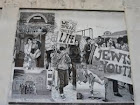
Jews and Mexicans in L. A..jpg
Mural Depicting Historic Relationship of Mexicans and Jews, at Canters Deli, Fairfax Avenue

Breed Street Shul Today.jpg
Breed Street Shul, (Congregation Talmud Torah), Oldest Synagogue in Boyle Heights.  Now a community historical interpretive center for the history of Boyle Heights.
Zellman's Men's Wear, Circa 2000, on Cesar Chavez Ave. (Ex-Brooklyn Ave.)zellmansinbh_logo.jpg


Things are not so grim now as they appeared only 5 years ago for Mexican and Jewish Angelenos. 

Gentrification of formerly poor, dilapidated neighborhoods has aroused great controversy in the last 5 years but it has also brought about changes in demographics and social/community interactions not seen in 60 years.  The hipsters of 2015 are a varied group of mainly 20-30 year olds but of various races and ethnicities.  The commercial, artisitic, and architectural renaissance of Hollywood, Silver Lake, Echo Park, and, increasingly, Boyle Heights, have the hipsters and other affluent people  moving into communities once feared, now cool, trendy, and bringing cultural communities once isolated from one another into living, working, and eating with each other.  The hipsters, who come from the Westside, the Valley, and from all over the United States, no longer look only to Hollywood and the Westside as their "port of entry" into living in Los Angeles.  The fears that kept Jews and Mexicans away from each other for decades have largely faded away as the different ethnicities living in gentrified communities see themselves as fellow artists, music lovers, peers, than they has been the case for decades.  The descendants of Jews that lived in Boyle Heights have spearheaded a consciousness among L. A. Jews of the rich Jewish heritage of Jewish life in Los Angeles and the importance that Boyle Heights has played in rediscovering the history of multicultural harmony among Los Angeles' ethnicities,  renewing a particular pride in being a Los Angeles Jew that does not play second fiddle to New York, Chicago or Israeli notions of Jewish life. 

The new fusion brought about by gentrification has created foods that exist only in Los Angeles: Korean Tacos, breakfast sushi, iced green boba tea, and the Kosher Burrito.  There is Mexikosher, a kosher restaurant serving kosher versions of Mexican food over on the Westide, near Pico and Robertson Blvds., owned and operated by Japanese-Mexican chef, Katsuji Tanabe.  Only in L. A., right? www.mexikosher.com

While much more community bridge building between the Mexican and Jewish Angelenos still needs to occur to overcome the separation, isolation, and mistrust of the two communities over the last 70 years, the man who symbolizes Los Angeles to us and to the world, Mayor Eric Garcetti is, himself, the physical embodiment of the relationship between Mexicans and Jews in Los Angeles.  Actually, Mayor Garcetti embodies the foundations of Los Angeles by being of Mexican, Italian, and Jewish descent.  Since his administration has called attention to and promoted multicultural living in Los Angeles, the future looks bright for Angelenos to experience the very old and special relationship between the Mexicans and Jews of Los Angeles.  


Hasta la vista, Booby!

EricGarcetti2.jpg


City Seal.jpg


1 / 1